SKINLONGEVITYATLAS
The Biology of Skin Aging & Resilience
WHAT SKIN LONGEVITY MEANS
Skin longevity means moving beyond correcting the visible signs of aging to optimizing skin health at its biological core, preserving its ability to protect, renew, repair and remain resilient throughout life.
Discover the levels of skin organization, meet their cells, explore the machinery within them, connect the networks and zoom out to understand long-term skin resilience.
DIMENSION 01 / DISCOVER
What is skin?
From Surface to Depth / Five Levels of Skin Organization
From the microorganisms living at its surface to the tissues that support it beneath, skin is a complex, interconnected biological system. Each level has distinct functions, yet none works in isolation. Together, they help maintain protection, structure and resilience over time. As these levels change with age, their interactions change too—influencing how skin looks, feels and functions.
THE FIVE LEVELS OF SKIN ORGANIZATION
The five levels are a guide to skin organization: the microbiome lives on the surface, the hypodermis lies beneath the skin, and underlying muscle supports movement. They are not all anatomical skin layers.
What happens in one level of skin does not always stay there. The levels support and influence each other; these relationships are called interconnections. A feedback loop occurs when a change in one level affects another, which then influences the first in return. These loops can help maintain balance, while some may amplify age-related changes.
INTERCONNECTION AND FEEDBACK LOOPS
FROM DIMENSION 01 TO DIMENSION 02
Together, these five levels form an interconnected system that shapes the skin’s structure, appearance and function. Within each level, specialized cells and microorganisms play distinct roles, carrying out the essential tasks that keep skin working as it should. Let’s take a closer look at who they are.
DIMENSION 02 / EXPLORE
Who lives and works within it?
Meet the cells and microorganisms within each level
Now, let’s dive deeper. Within the five levels lives a diverse world of specialized cells and microorganisms, each with a distinct role. Their everyday work helps protect, renew, repair and support the skin over time. Let’s meet some of the key players.
SOME OF THE KEY PLAYERS
FROM DIMENSION 02 TO DIMENSION 03
These cells and microorganisms have different jobs. Inside most living human skin cells, however, the same essential machinery helps preserve genetic information, produce energy and repair damage. Understanding how that machinery works, and changes with age, is the next step.
DIMENSION 03 / GO DEEPER
What happens inside our cells?
The machinery that helps cells function and remain resilient
Let’s go even deeper—inside our skin cells. DNA, mitochondria and cellular maintenance systems provide the instructions, energy and repair capacity that help cells carry out their work and maintain function over time.
INSIDE THE CELL
A skin cell is a highly organized living unit, where DNA, mitochondria and cellular maintenance systems are closely interconnected. Let’s discover how these essential components support and influence one another, and how changes in one can affect the others.
INTERCONNECTION AND FEEDBACK LOOPS
When Cellular Machinery Is Disrupted: Cellular Senescence
Damage to DNA, impaired mitochondrial function and less effective cellular maintenance can place skin cells under stress. When this stress or damage persists, some cells may enter a state called cellular senescence. These cells stop dividing but remain biologically active. This response can help prevent damaged cells from multiplying; however, certain senescent cells that persist may release signals that influence neighboring cells and tissues.
FROM DIMENSION 03 TO DIMENSION 04
Cellular senescence reveals an important connection: what happens inside a cell can influence other cells and tissues around it. But this is just one small part of a much larger picture. How do different cells, tissues and biological networks communicate and work together to keep our skin functioning as a whole?
DIMENSION 04 / CONNECT
How does everything work together?
Communication networks that link cells, tissues and skin levels
Discover how cells, tissues and biological networks exchange signals, move resources and respond together, helping maintain skin function, coordinate repair and support resilience over time.
THE COMMUNICATION NETWORKS
These networks link different levels of skin organization, allowing cells and tissues to work together. Some connections are physical, while others operate through signals or indirect effects. Let’s see how these communication networks connect the five levels of skin organization, allowing cells and tissues to exchange signals and coordinate their functions.
HOW THE NETWORKS CONNECT THE 5 LEVELS OF SKIN ORGANIZATION
But these networks don’t work independently. They continuously interact and influence one another, creating feedback loops where changes in one network can trigger changes in others.
INTERCONNECTION AND FEEDBACK LOOPS
FROM DIMENSION 04 TO DIMENSION 05
No matter how well the machinery inside cells, individual cells or entire tissues function, the skin’s long-term health depends on effective communication between them. As these interconnected networks change with age, their combined and cumulative effects reach across the entire skin, shaping its ability to protect, repair and remain resilient.
DIMENSION 05 / ZOOM OUT
The Bigger Picture: What Does Skin Longevity Really Depend On?
Four perspectives. One interconnected biological system.
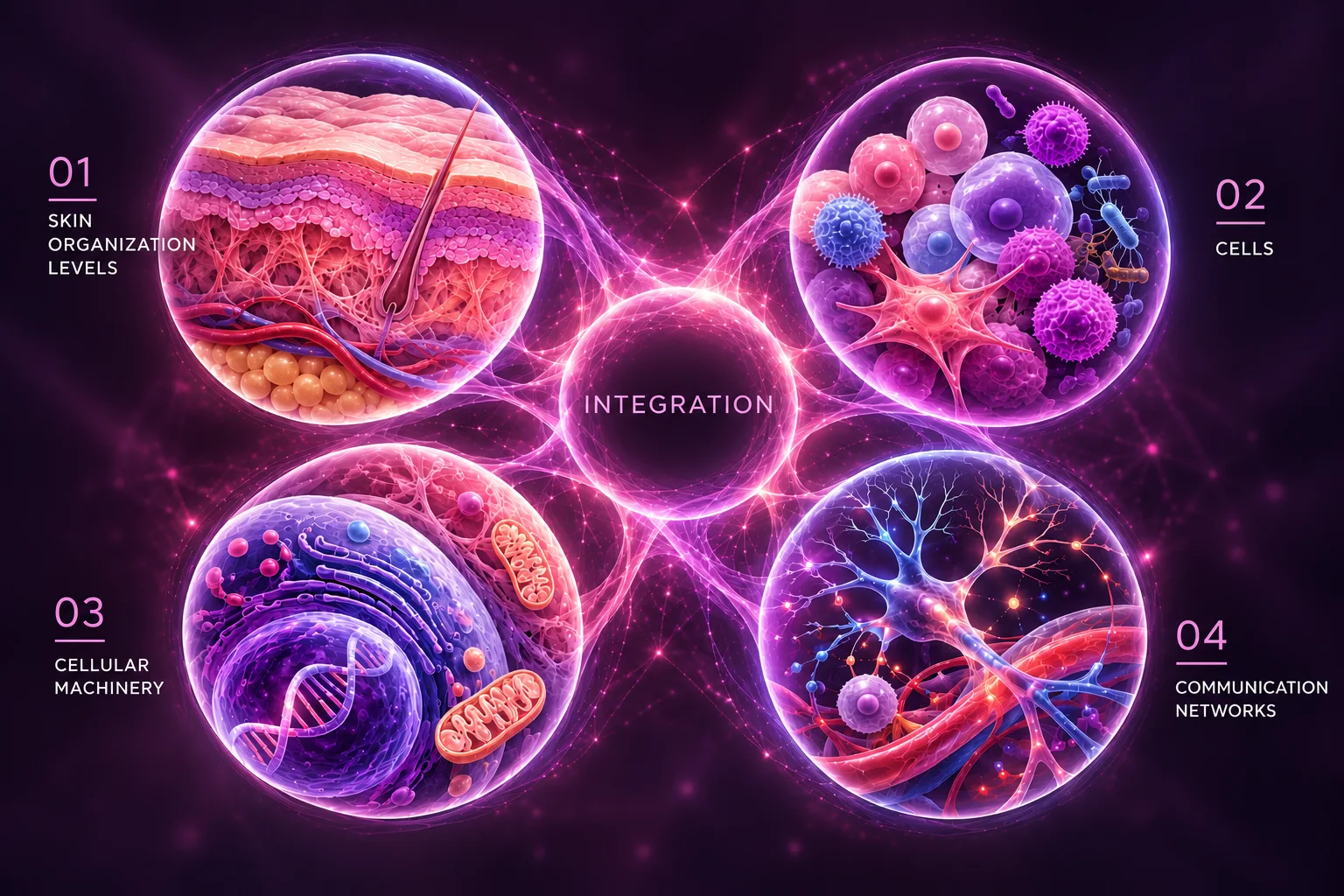
CONNECTING THE FOUR DIMENSIONS
Let’s zoom out and bring everything we’ve covered into one picture.
DIMENSION
WHAT WE’VE DISCOVERED
01 — SKIN ORGANIZATION LEVELS
Five interconnected levels form the skin’s structure and contribute to its overall function.
02 — CELLS
Specialized cells and microorganisms carry out the essential activities that keep these levels working.
03 — CELLULAR MACHINERY
Key machinery inside skin cells, DNA, mitochondria and maintenance systems work together to preserve cellular function.
04 — COMMUNICATION NETWORKS
Communication networks link cells and tissues, allowing different parts of the skin to influence one another.
These dimensions are not separate pieces of skin biology. They reveal different parts of one living, interconnected system, where changes at the molecular, cellular and tissue levels continuously influence one another.
KEY TAKEAWAYS
RETHINKING SKIN LONGEVITY THROUGH SYSTEMS BIOLOGY
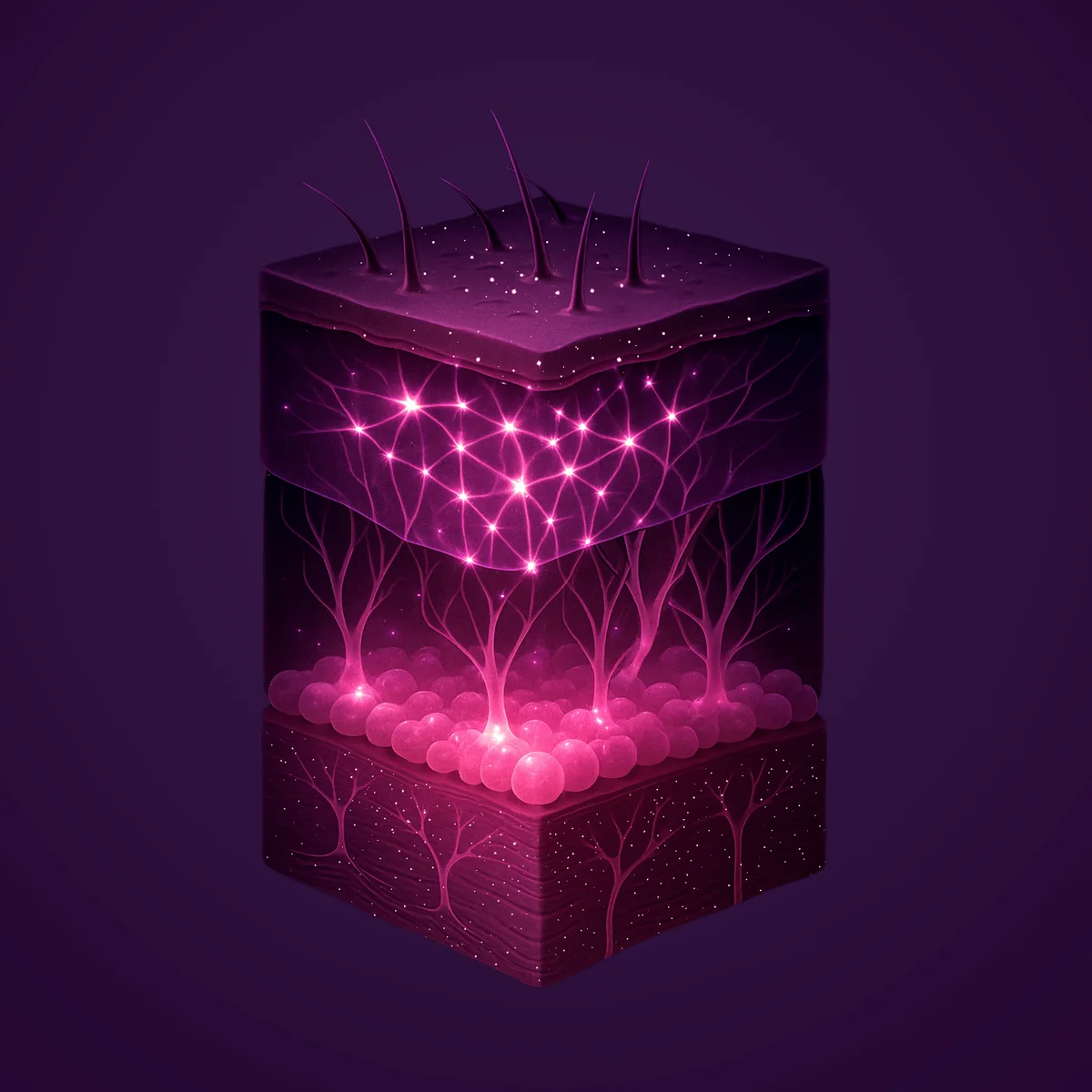
A systems biology approach to skin longevity represents a fundamental shift: from focusing on individual drivers and mechanisms of skin aging to understanding and supporting the interconnected biological system, where interactions between its components collectively shape skin health, function and resilience over time.
THE RESEARCH FOUNDATION OF SKIN LONGEVITY ATLAS
SCIENTIFIC EVIDENCE
One complete research collection. Explore the science behind the Atlas.